
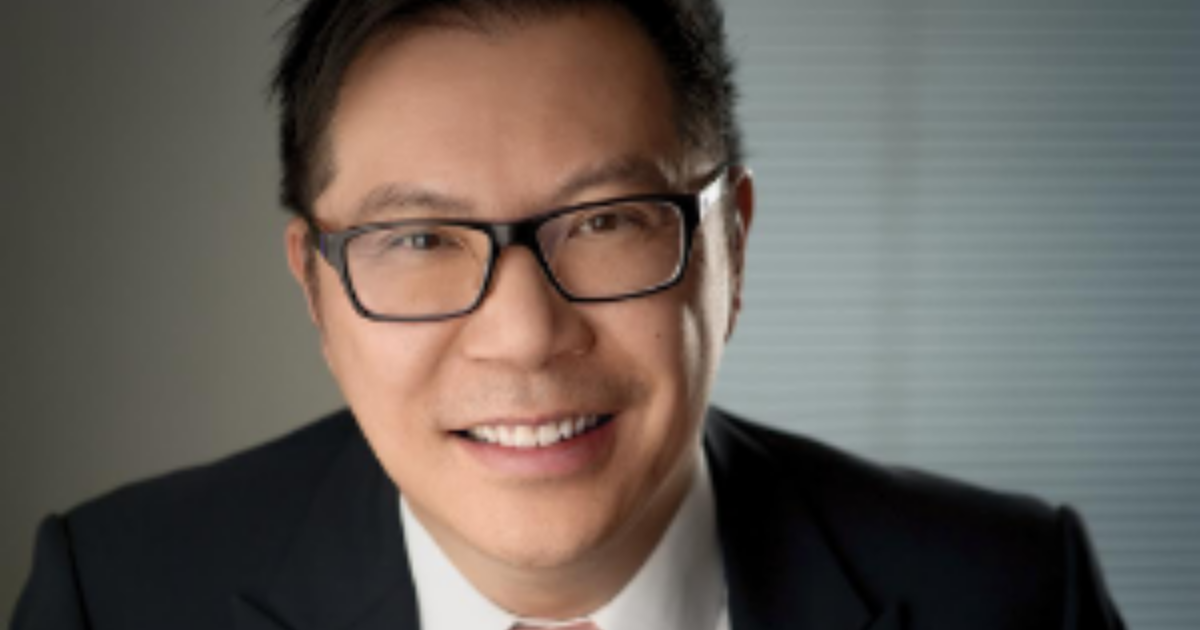
For more than three decades, Terry Hui has led Concord Pacific, Canada’s largest master-planned community builder, overseeing some of the country’s most ambitious and iconic urban redevelopment projects.
Since becoming CEO in the early 90’s, he has guided the company’s projects from its Vancouver base while also expanding interests into telecommunications, software, renewable energy, hospitality, and real estate investment management.
From Physics to Property Development
Terry Hui grew up in Hong Kong before moving to California as a teenager. There, he studied physics at the University of California, Berkeley, earning his degree in 1983, then completed a master’s degree in electrical engineering at Santa Clara University in 1985. Later that year, he moved to Vancouver.
He had originally planned to start a software business, but family property holdings brought him into real estate development, where he worked on projects including Vancouver’s Cambridge Gardens near Cambie Street and 10th Avenue.
Soon after Hui began his career in development there was a major transition for Vancouver. Li Ka-shing, a Hong Kong billionaire businessman, led a consortium that acquired the city’s former Expo 86 lands in 1988, with Concord Pacific created to develop the property. The Hui family was part of the original consortium. After the company went public for a brief period, the Hui family took over ownership and made it private again in the early 2000’s.
Transforming Vancouver Through the Expo 86 Lands
The skyline-evolving assignment that has defined Terry Hui’s career is Concord Pacific Place along Vancouver’s False Creek.
Construction began in the early 1990s after Vancouver planners moved the proposal toward a connected urban community. Residential towers were built alongside parks, retail areas, community centre, childcare facilities, school sites, pedestrian routes, and waterfront road and service infrastructure.
Today, it contains more than 11,000 homes across eight completed neighbourhoods, with about three kilometres of seawall and extensive public parks and pathways.
The project changed Vancouver’s downtown geography on a scale rarely attempted by a private developer. Former Expo grounds became a permanent residential district with tens of thousands of residents and more than half of it is public realm. The planning approach behind the development has since attracted attention from planners worldwide studying high-density communities.
Bringing Concord Pacific Model to Toronto
Terry Hui took Concord Pacific’s large-scale development model to Toronto in the late 1990s. CityPlace, now a core downtown neighbourhood, was developed on former railway lands beside the CN Tower and Rogers Centre.
The 45-acre project is almost complete with approximately 30 residential towers, more than 18,000 residents, 120,000 square feet of retail space, an eight-acre park, schools, a library and a community centre.
Concord Pacific subsequently developed Concord Park Place in North York, expanding its Toronto presence beyond downtown.
After its successful expansion into Toronto, Hui further expanded the company through international markets, with development activities in Seattle and London UK. This move added Concord Pacific projects in two additional countries alongside its Canadian portfolio.
Continuing to Build Beyond Real Estate
As Concord Pacific’s real estate projects took off, Terry Hui also used the company as a base for ventures in technology and infrastructure.
He launched Novus Entertainment in 1996 to provide high-speed fibre-optic services to Concord Pacific communities and other multi-family properties. Hui expanded into software withMaximizer, a Vancouver CRM company.
Renewable energy became another major business. Concord’s energy operations under Concord Green Energy have included solar, wind, and hydroelectric projects across Canada with over 500 megawatts of renewables in their portfolio. The group has also developed renewable-energy projects with First Nations communities in Alberta.
Hui’s pursuit of technology and efficiency has found its way into Concord Pacific developments. The company was first to have fibre-connected communities, high-speed internet infrastructure, electric-vehicle charging facilities, and include water damage protection systems to mitigate water related incidents.
Recognition, Leadership, and Community Impact
In recognition of his work as CEO of Concord Pacific, Terry Hui received the Queen’s Golden Jubilee Medal and the Rix Award for Engaged Community Citizenship. He has also been recognized as a UN Global Citizens Laureate.
His public appointments have included the Business Advisory Council to APEC and the Prime Minister’s Business Advisory Council on Asia-Pacific. He also serves as a director of the Greater Vancouver Board of Trade and is a co-founder and board member of the Quantum Gravity Society.
His interests outside business include cycling, skiing, and competitive sailing, where he has also contributed support. In 2024, Concord Pacific provided lead sponsorship and assembled coaching and operations for Team Canada competing in the inaugural Women’s America’s Cup and the Youth America’s Cup in Barcelona.
Shaping Canadian Cities for More Than Three Decades
Terry Hui’s tenure has taken Concord Pacific from developing Concord Pacific Place to becoming a diversified group with operations and investments spanning several industries and countries.
While Terry Hui’s net worth is not publicly disclosed, his position as CEO of Concord Pacific places him at the helm of one of Canada’s most significant, privately held development companies.
The former Expo 86 property remains the clearest measure of his impact as a developer, as the land now serves as the most prominent part of Vancouver’s skyline. Under his leadership, Concord Pacific turned a temporary exhibition site into a massive permanent community on False Creek. Additionally, the company’s Toronto projects placed thousands of homes on former railway land beside one of Canada’s most recognizable landmarks. Beyond towers, Concord is also the largest private provider of park land and public art in Canada.
More than 30 years into his career, Hui continues to shape Canadian cities through the communities, infrastructure, and investments he builds across the country.
Free downloads for founders
Get the weekly startup funding tracker, the founder press checklist, and the CEO Medium media kit. Enter your work email and they're yours.
Browse free resourcesFollow CEO Medium
Leadership stories & founder interviews, wherever you are.
