
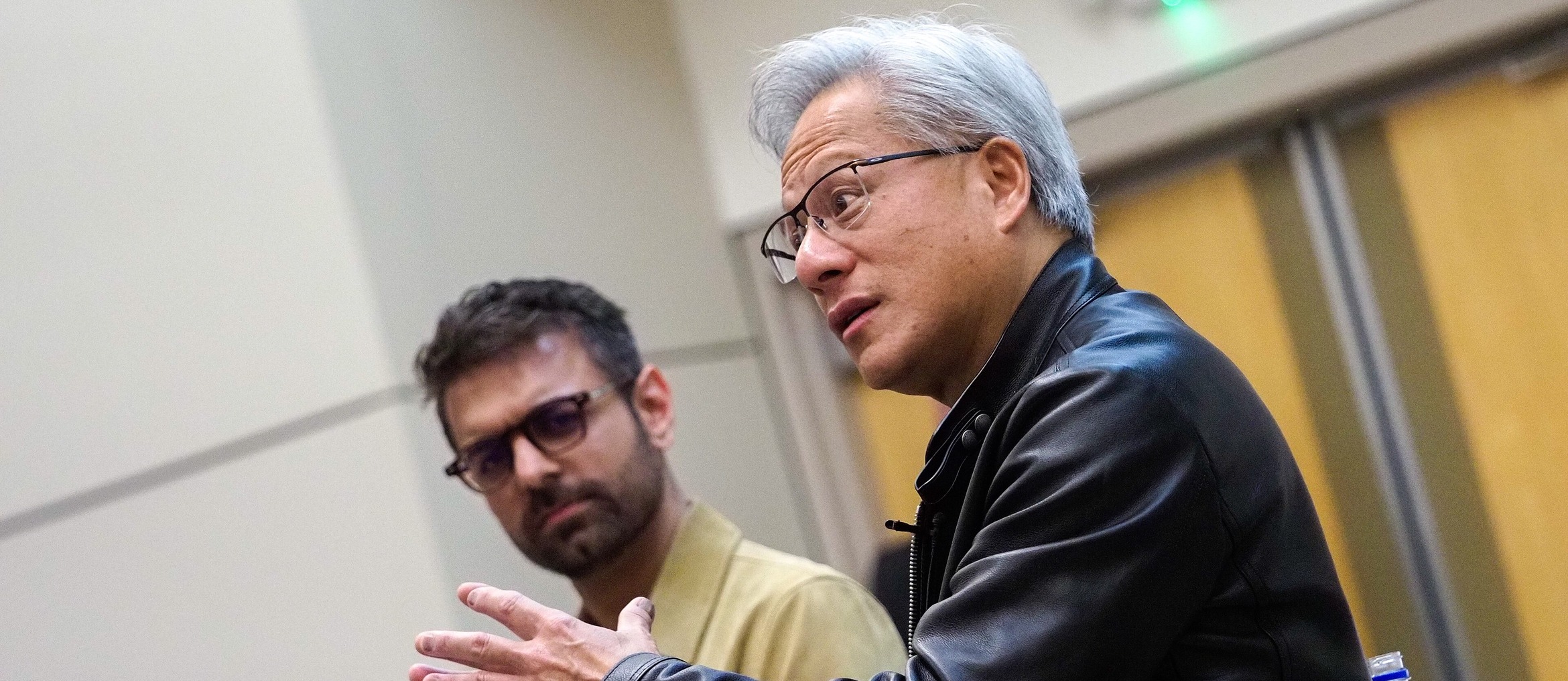
Jensen Huang reinstated Nvidia CEO is the headline that broke the market on Monday morning. Eleven days after he resigned over revelations about his personal life, the board that said it would not take him back voted unanimously to do exactly that, and the stock closed up 31.5 percent. The comeback settles who runs one of the most valuable companies on earth. It does not settle how the board got there, or what it will do the next time the founder is the problem.
## Jensen Huang reinstated Nvidia CEO: how the board got from no to yes in six days
Start with the timeline, because the timeline is the story. Huang resigned on November 12 after 33 years as chief executive, following revelations of extramarital affairs, including one with Alice Huang, a businesswoman US authorities suspect of having ties to Chinese intelligence. Beijing denies the allegation. The board appointed chief financial officer Colette Kress as interim chief executive and hired a search firm to find a permanent replacement.
On November 17, on the earnings call, board chairman Harvey Jones said the board had unanimously accepted Huang’s resignation and did not intend to reinstate him as chief executive. That was six days before the reversal. In between, the pressure built from every direction at once. A petition calling for Huang’s return drew more than 180,000 signatures, including one from Elon Musk. Employees, shareholders and business partners urged the board to reconsider. Some prospective replacement candidates had already withdrawn from consideration, according to Bloomberg.
Then, on Sunday afternoon, the board reached the opposite decision in a discussion that lasted just a few hours, according to Bloomberg. Interim chief executive Colette Kress and other senior executives were excluded from the discussions and learned of the decision only at the last minute, Bloomberg reported. Nvidia announced the comeback shortly before markets opened on Monday, and filed a Form 8-K. The board said it had held a series of discussions and meetings with Huang and was satisfied with his candour and ability to lead.
Jones put it this way in the statement: “The Board believes Jensen is the right person to lead NVIDIA, and that his reinstatement is in the best interests of our stockholders, employees, partners and customers.” Huang said: “I am honored to return to NVIDIA and lead one of the most consequential technology companies in the world at the beginning of a new industrial revolution. I can’t wait to get back to work.” Kress stays on as chief financial officer.
## Trump called, and the board listened
No honest account of this weekend can leave out the president. Trump said last week that he wanted Huang back, and on November 16 told reporters he “would certainly not mind” seeing him return. On Sunday he wrote on Truth Social: “I hope the Board of NVIDIA rehires Jensen Huang. It would be the best thing for the Company, and also, for the U.S.A.”
On Monday, Trump told CNBC that he had spoken to the board. “And I convinced them,” he said. “I made the deal.” He told the broadcaster his intervention was “very important”, that he had spoken to Huang on Sunday night, and that he had been represented at the board meeting. The White House confirmed on November 23 that Trump called into an Nvidia board meeting. On Truth Social, Trump called Huang a “Great Patriot and National Treasure” and said the board had made the “correct and proper decision”. He also wrote that the US government had no reason to believe Huang’s return posed a national security threat, and that the Attorney General had confirmed the government did not possess evidence that Huang had engaged in any unlawful conduct.
There is a second Trump fact that belongs in the same section. CNBC reported last week that Trump’s investment accounts have traded between $27 million and $97.5 million of Nvidia stock since he returned to office in January 2025, including a sale of between $500,000 and $1 million after he was reportedly briefed on Huang’s affair in May. The White House told Reuters that third-party financial institutions manage Trump’s portfolio.
The board’s own stated reason for the reversal was different. It said it had received input from senior levels of the US government and, on that basis, was confident the reinstatement posed no national security risk. Both things can be true at once. A president leaning on a public company’s board to restore a chief executive is not normal, and it should not be reported as if it were.
## The market voted before the board finished explaining
The numbers tell you how the market read the weekend. Shares rose 31 percent in premarket trading and closed at $165.05, up 31.5 percent from Friday’s close of $125.53. Barron’s reported the stock up 32 percent to $166.01 during the session, on pace for its largest one-day percentage increase since May 9, 2003, according to Dow Jones Market Data. The Nasdaq rose about 7.5 percent on the day. Short sellers faced about $12.2 billion in paper losses, their biggest one-day hit since at least 2019, according to ORTEX.
The surge needs its context. The stock had fallen 28 percent from Huang’s resignation through Friday’s close, and Friday’s $125.53 close was a 52-week closing low. The company had also just reported quarterly revenue of $115.8 billion on November 17, its biggest quarter in its history, five days after Huang stepped down. The business was fine. The leadership was the question, and the market answered it in a morning.
Wall Street analyst Dan Ives said the board had little choice but to bring Huang back, and put Nvidia at $300 a share with Huang at the helm against $225 without him, while keeping his official $225 price target. That is the uncomfortable part CEO Medium should say plainly: shareholders just voted with their wallets that conduct does not matter if the chips ship. That is a real argument, and it is also the argument that makes governance meaningless.
## What has not changed
The comeback settles the leadership question. It does not settle the security one. Nvidia said its independent investigation into reports that Huang was targeted by a foreign intelligence operation will continue despite his reinstatement. A committee made up only of independent directors is leading it, with independent counsel, and the company says it “will proceed to conclusion”. Huang said he fully supports the investigation and will cooperate. He is set to testify before Congress on December 1.
The board also created a new National Security and Export Control Committee made up solely of independent directors, and began a search for a new Chief Compliance Officer who will report to the Nominating and Corporate Governance Committee. California Attorney General Rob Bonta’s office said the reinstatement does not diminish the need for a probe into what Nvidia told investors about its China ties. Lawmakers criticised the decision and said Congress must pass export control legislation and get answers.
The underlying allegations remain exactly what they were: reported, not confirmed. The New York Times reported that Alice Huang was in contact with an officer of China’s Ministry of State Security from spring 2025 until fall 2026, a period that overlapped with the affair, and that her business partner Kang Wei worked with the same agency. The report also says the pair were scrutinised over a network of Southeast Asian companies, including Singapore-based Megaspeed, suspected of diverting advanced Nvidia chips to China. Megaspeed has denied wrongdoing and Beijing has dismissed the espionage allegations as unfounded. The Times also reported an affair with Kimberly Powell, Nvidia’s vice president of healthcare, who reported directly to Huang. None of this is proven. The board’s decision does not prove it, and neither does the stock price.
## What founders should take from it
Indispensability is the strongest governance defence there is, and the weakest business strategy. Huang held the role for 33 years, kept a tight grip on the chip roadmap, the major customer relationships and the ties with Washington, and groomed no obvious successor. When he left, the company scrambled. A petition, a president and a 28 percent share price fall did the rest. If you are indispensable, the rules bend for you, until the day they do not.
And if you sit on a board, understand what your independence is actually worth when the stock drops, the employees petition, and the White House calls. The answer this weekend was: not much. A board that cannot replace its founder is not protecting the founder. It is trapped with him. Build the bench before you need it, because the weekend you need it is the weekend you will not have it.
Silicon Valley got its wish within the hour. Sam Altman posted “Jensen!” on X. Elon Musk posted “it is done”, and on Nvidia’s own announcement added: “The mistake has been corrected.” Musk and Epic Games chief executive Tim Sweeney were among the signatories of a public letter claiming the board did not follow its own code of conduct in Huang’s resignation. Nvidia’s developer conference in Washington next week, planned without its longtime boss, is now expected to showcase his return.
The question now is what the board does the next time the founder is the problem, because this weekend taught every founder watching that the answer might be nothing.
For more on the leaders shaping this moment, read the rest of our [News](https://ceomedium.com/category/news/) and [CEOs](https://ceomedium.com/category/influencer/) coverage, including [how Jensen Huang ran Nvidia on humiliation, and called it greatness](https://ceomedium.com/jensen-huang-humiliation-management-style/) and [how Qualcomm cut 517 jobs and called it a performance problem](https://ceomedium.com/qualcomm-layoffs-cristiano-amon/).
Free downloads for founders
Get the weekly startup funding tracker, the founder press checklist, and the CEO Medium media kit. Enter your work email and they're yours.
Browse free resourcesFollow CEO Medium
Leadership stories & founder interviews, wherever you are.
