
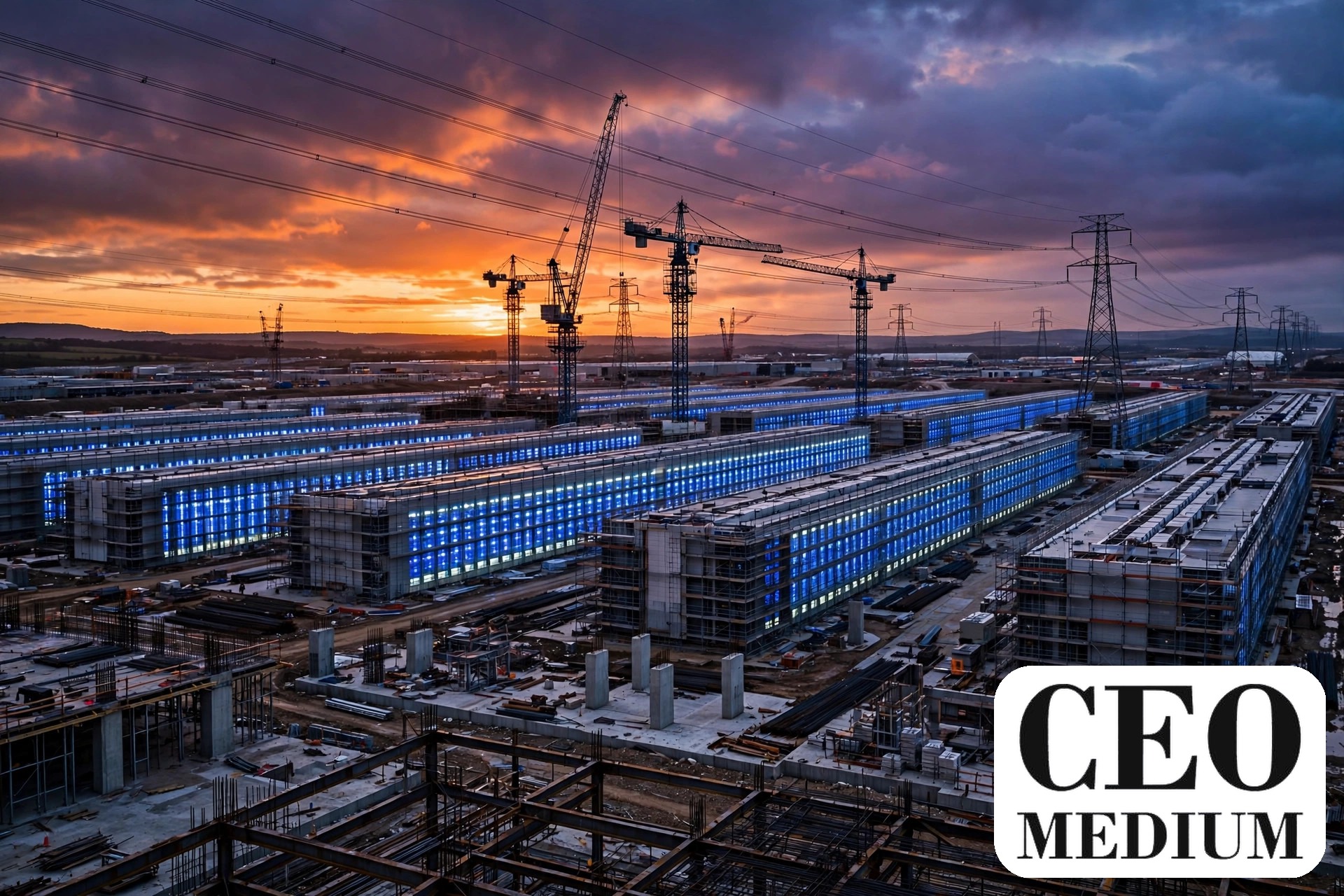
Larry Fink issued a data center recession warning on Wednesday morning that every founder building on AI should read twice. Asked by CNBC about the push to halt data center construction across the United States, the BlackRock CEO did not hedge. “If we have a moratorium of some sort in this country, we will be in a recession,” he said. Fink spoke hours after BlackRock reported third-quarter results, with the firm now managing a record $15.49 trillion in assets.
The context matters. In fact, BlackRock posted adjusted earnings of $15.93 per share on $7.75 billion in revenue, with $205 billion in net inflows. The stock ticked up about 1 percent. Then Fink used the spotlight to say the quiet part out loud: the American economy is now load-bearing on concrete, chips, and power lines. “So much of our economy is based on the buildout of this capex,” he said.
The numbers behind the Larry Fink data center recession warning
Fink’s claim rests on forecasts, and they should be read as forecasts, not money already spent. For instance, Wall Street estimates put AI capital spending above $1 trillion in 2027 and above $5 trillion by 2030. Moody’s estimates roughly $700 billion this year and $2.4 to $2.48 trillion through 2030. The global figure nears $7 trillion by the end of the decade. Harvard economist Jason Furman has calculated that tech investment drove about 92 percent of US growth in the first half of 2025.
Still, those are projections, and projections can be wrong. But Fink’s point is about the present tense. The spending happening right now, the cranes in the ground today, is doing real work in GDP math. Stop the buildout and you stop a growth engine with nothing ready to replace it. That is the recession mechanism he is describing, and it does not require believing every 2030 forecast.
Why communities want the trucks to stop
The backlash is not abstract. Towns near proposed data centers are fighting over rising utility bills, water consumption, and environmental damage. For example, Pew Research found at least 49 percent of Americans say data centers hurt the environment, energy costs, and quality of life. The fight has become a live issue in the November 3 midterm elections, with voters pressing candidates on utility bills and deal transparency.
However, this is the honest tension at the center of the story. National GDP math says keep building. Local household math says the bills are already too high. Both can be true at once, and founders who dismiss the local side are misreading the politics. Meanwhile, a Forbes post about Fink’s comments drew roughly 2,000 likes and 890 comments within a day, overwhelmingly critical. The anger is real, and it votes.
“Data centers are not the problem”
Fink’s rebuttal was blunt. He called most of the opposition “misinformation” and insisted “data centers are not the problem.” His case: the buildout creates jobs across construction, electrical work, plumbing, welding, and grid power. The facilities themselves keep getting more efficient. In the same interview he argued the economic activity around the buildout is broad-based, not confined to tech campuses.
He has a point about jobs, and the efficiency gains are real. However, “misinformation” is doing a lot of work in that sentence. Utility bills in data center towns are on the record, not rumored. Utilities meter water usage. Dismissing every concern as misinformation is the kind of overreach that turns skeptics into opponents. That dynamic is now showing up in midterm races.
The interest Fink did not hide, and neither should we
Here is the disclosure that belongs in every version of this story: Larry Fink is not a neutral observer. BlackRock is one of the great financiers of the AI infrastructure buildout. On CNBC, Fink said the firm is working with AMD, Broadcom, and Google on financing models based on chip residual value. The chip-financing detail comes from the same interview. When the man selling the shovels tells you the digging must continue, note the position.
But that is also why the warning is worth hearing instead of dismissing. The money doing the building just told you, on the record, that the building is the growth. That is not a pitch. It is a risk disclosure from inside the trade. Founders should treat it the way they would treat any material disclosure from a counterparty: discount the spin, keep the data.
For more on how CEOs make these macro calls, see our Leadership & Management hub. We have covered the infrastructure angle before. That includes Matt Garman’s data center NDA reversal at AWS and Sam Altman’s warning about CEOs blaming AI for layoffs.
What founders should actually do
First, price the political risk of your compute supply chain, not just the technical risk. If your AI strategy assumes cheap, endless compute, the variable you are underpricing is not model quality. It is the permitting office, the utility commission, and the ballot box.
Watch the moratorium debate the way you would watch any recession indicator. Meanwhile, track which states and counties are pausing approvals, what candidates are saying about utility rates, and where the next fights are heating up. The concrete trucks are the economy now, in Fink’s telling. Whether he is right or self-interested, and he is both, the trucks are worth watching.
Free downloads for founders
Get the weekly startup funding tracker, the founder press checklist, and the CEO Medium media kit. Enter your work email and they're yours.
Browse free resourcesFollow CEO Medium
Leadership stories & founder interviews, wherever you are.
