
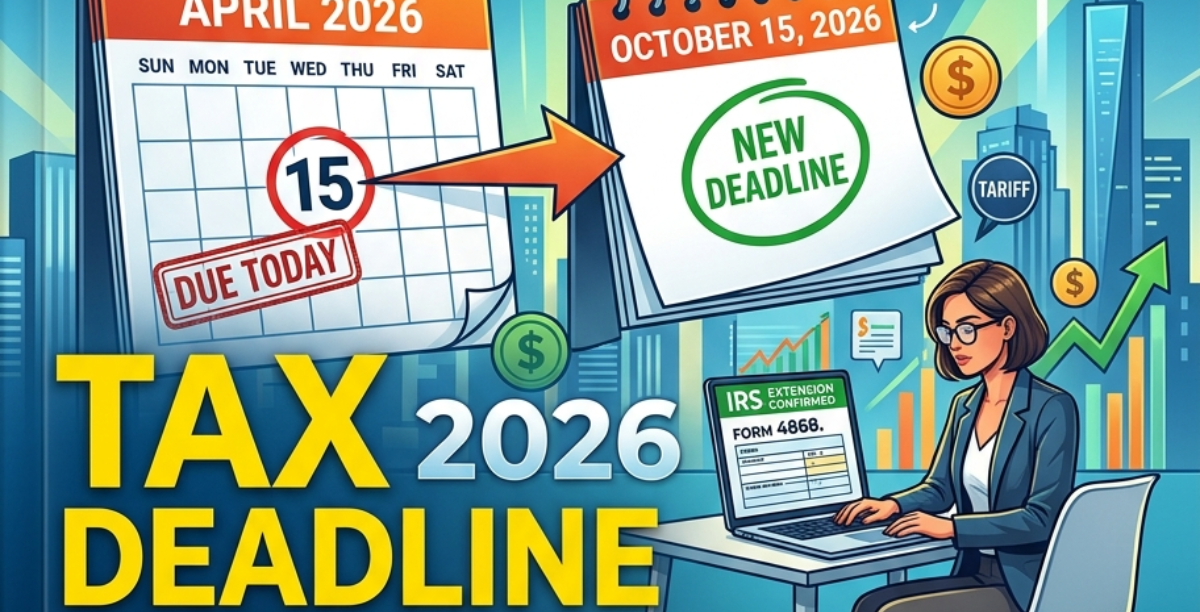
Tax Extension 2026: The Entrepreneur’s Essential Guide to April 15
It is April 15, 2026, and today is the federal tax deadline. If you are a small business owner, entrepreneur, or freelancer, securing a tax extension 2026 is the most critical move you can make right now if you aren’t ready to file. An extension is straightforward, automatic, and available to almost every business entity—as long as you request it by midnight tonight to avoid the steep penalties that kick in immediately.
This guide covers everything you need to know about the 2026 tax extension: who qualifies, which form to file, key deadlines by business type, the one critical mistake most entrepreneurs make, and where to file for free in the next few hours.
What Is a Tax Extension and What Does It Actually Give You?
A tax extension gives you additional time to file your tax return not additional time to pay any taxes you owe.
This distinction is critical and is the most common source of confusion among small business owners filing extensions for the first time.
When you file a tax extension:
- You get 6 additional months to file your complete tax return
- Your new filing deadline becomes October 15, 2026
- Any taxes you owe are still due today, April 15
- Interest and late payment penalties apply to any unpaid balance after today
- There is no penalty for filing the extension itself as long as you file it on time
The IRS is clear on this point: filing an extension, even if you cannot pay in full is always better than failing to file at all, because late-filing penalties are significantly steeper than late-payment penalties.
2026 Tax Extension Deadlines by Business Type
Different business structures have different deadlines. Here is the complete breakdown for 2026:
Already passed:
- March 16, 2026 Extension deadline for S-Corporations (Form 1120-S) and Partnerships (Form 1065) and multi-member LLCs. If you missed this deadline, file your return as soon as possible to minimize penalties.
Today April 15, 2026:
- Sole proprietors filing Schedule C with Form 1040
- Single-member LLCs treated as disregarded entities
- C-Corporations filing Form 1120
- Individual taxpayers including freelancers and self-employed entrepreneurs
Extended deadlines after filing today:
- October 15, 2026 – New filing deadline for most individual and C-corp returns after extension
- September 15, 2026 – Extended deadline for S-corp and partnership returns
Which Form Do You Need to File?
Individuals, sole proprietors, single-member LLCs, and freelancers: File Form 4868 – Application for Automatic Extension of Time to File U.S. Individual Income Tax Return
C-Corporations, S-Corporations, and Partnerships: File Form 7004 – Application for Automatic Extension of Time to File Certain Business Income Tax, Information, and Other Returns
Nonprofits and charities: File Form 8868
How to File Your Tax Extension Today – Free Options
You have several free options to file your extension before tonight’s deadline:
Option 1 – IRS Direct Pay (Fastest) Go to IRS.gov → Direct Pay → make a payment and select “Extension” as the reason. This automatically submits your extension request without needing to fill out a separate form. Save your confirmation number.
Option 2 – IRS Free File All individual filers can use IRS Free File at IRS.gov to electronically request an extension at no cost, regardless of income level. This is completely free and takes less than ten minutes.
Option 3 – Free File Fillable Forms Complete and submit Form 4868 electronically through IRS Free File Fillable Forms. Available to all taxpayers regardless of income.
Option 4 – Tax Software TurboTax, TaxAct, H&R Block, and most major tax software platforms allow you to file Form 4868 directly through their interface. Some charge a small fee depending on the service level.
The One Mistake Most Entrepreneurs Make With Tax Extensions
The most common and costly mistake small business owners make when filing a tax extension is treating it as a payment extension.
It is not.
If you owe taxes and do not pay an estimate of that amount today, the IRS will charge you interest plus a late payment penalty of 0.5% per month on the unpaid balance even if you filed your extension correctly and on time.
Here is what to do instead:
Step 1: Make your best estimate of your total tax liability for 2025
Step 2: Subtract any payments you have already made estimated quarterly payments, withholding, etc.
Step 3: Pay the remaining estimated balance today using IRS Direct Pay, a debit card, credit card, or digital wallet
Step 4: File your extension form
You do not need to be exact. An honest best estimate, with payment of what you can, significantly reduces your penalty exposure compared to paying nothing. If you end up overpaying, you will receive the difference as a refund when you file your complete return.
What Happens After You File the Extension?
Once your extension is filed and your estimated tax payment is submitted, you have until October 15, 2026 to complete and file your full return.
Use that time wisely:
- Gather all outstanding tax documents – 1099s, receipts, business expense records, mileage logs
- Work with a CPA or tax professional to prepare your complete return accurately
- Review whether the tariff costs your business absorbed in 2025 are properly deducted as business expenses
- Consider whether your business structure is still the most tax-efficient option for your situation going into 2026
The extension period is not just extra time to procrastinate. It is an opportunity to file a more accurate, more complete, and potentially more advantageous return than you could have prepared under the pressure of today’s deadline.
The Bigger Tax Picture for Entrepreneurs in 2026
Today’s deadline is part of a broader tax environment that is creating real pressure on small business owners this year.
The tariff increases that took effect throughout 2025 are creating significant deductible business expenses for many small businesses costs that are worth documenting carefully and claiming properly. If your business absorbed higher costs for imported goods, materials, or supplies due to tariffs, those costs are generally deductible business expenses.
Interest rates, while stabilizing, remain elevated compared to pre-2023 levels making the cost of any tax debt or payment plans more significant than they were in previous years.
And the ongoing uncertainty around the Supreme Court’s IEEPA tariff rulings means that some businesses that paid certain tariffs in 2025 may eventually be entitled to refunds which is another reason why accurate record-keeping and a well-prepared tax return matters more this year than usual.
Final Thoughts: File the Extension, Then Focus Forward
If you are not ready to file your complete return today, file the extension now. It takes ten minutes, it is free, and it eliminates the most severe penalties immediately.
Pay what you can estimate you owe. Document the payment. Move your new deadline to October 15 and use the time between now and then to prepare a thorough, accurate return with professional support if needed.
Tax compliance is one of the fundamentals of building a sustainable business. The entrepreneurs who handle it systematically without panic, without procrastination, and without paying more than they owe are the ones who keep more of what they earn and build the financial foundationfinancial foundation that makes everything else possible.
CEO Medium covers the news, strategies that matter to entrepreneurs and business leaders. Get Featured Today or email info@ceomedium.com
Follow CEO Medium
Leadership stories & founder interviews, wherever you are.
