
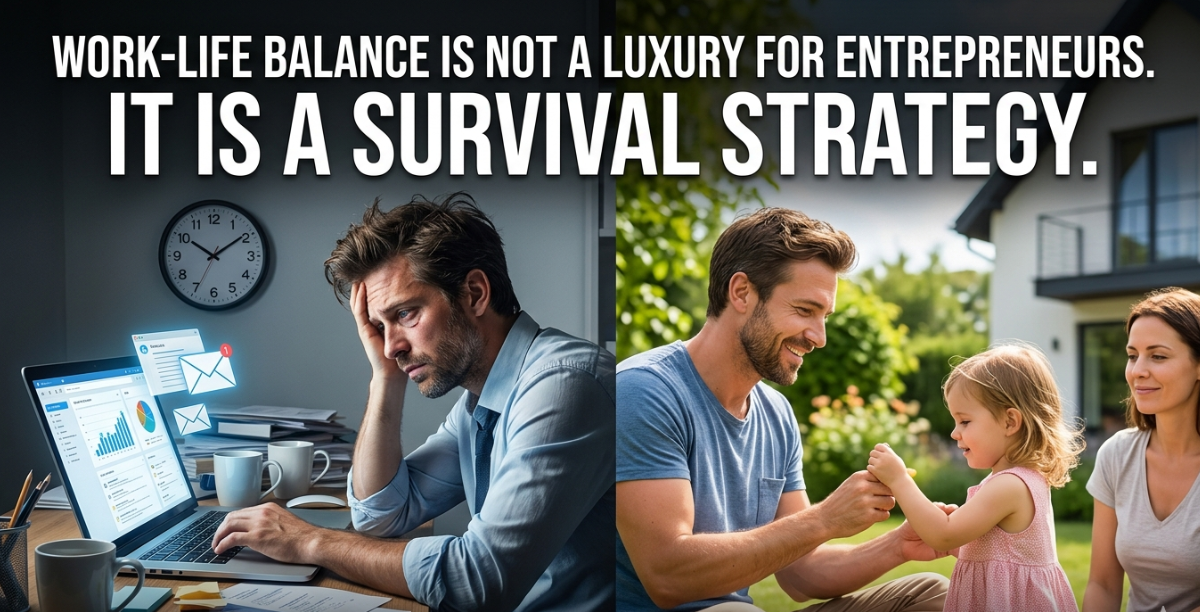
Work-life balance is not a luxury for entrepreneurs. It is a survival strategy.

Most business owners discover this truth too late. They spend months working 80-hour weeks and missing family moments. Eventually, they face a creeping exhaustion that no amount of coffee can fix. They built the business they dreamed of, but they forgot to build the life that was supposed to come with it.

In my experience working alongside entrepreneurs and business builders, the ones who sustain high performance over years, not just months, are not the ones who work the hardest. They are the ones who figured out how to protect their energy, set boundaries that actually hold, and build businesses that run without requiring their constant presence.

This guide is for every entrepreneur who knows they need to find better balance but has not figured out how to do it without feeling like they are falling behind. The strategies here are practical, honest, and built for the reality of running a business in 2026, not a corporate job with fixed hours and a clear off switch.

Why Work Life Balance Is Harder for Entrepreneurs Than Anyone Else

Before diving into solutions it is worth acknowledging something that most productivity guides skip over entirely: work life balance is genuinely harder for entrepreneurs than it is for employees, and the reasons matter.

Your business lives in your head 24 hours a day. While an employee can clock out, an entrepreneur carries the business everywhere. You might face a strategy question at 11 PM or a client problem during dinner. Consequently, the mental load of ownership rarely respects office hours.

Furthermore, there is always more you could be doing. Since the to-do list never ends, the decision to stop working often feels like a choice to fall behind.

There is always more you could be doing. The to-do list of a business owner never ends. There is always another email to send, another system to improve, another opportunity to pursue. The ceiling on productive work is infinite, which means the decision to stop working always feels like a choice to fall behind.

Your identity and your business are deeply intertwined. For many entrepreneurs, the business is not just what they do, it is who they are. This makes disengaging feel like losing yourself rather than simply logging off, and it makes burnout particularly difficult to recognize until it is severe.

The culture celebrates overwork. The entrepreneurship community has historically glorified hustle culture, the founder who sleeps four hours, the CEO who has not taken a vacation in three years, the startup team that treats exhaustion as a badge of honor. This cultural norm makes it harder to prioritize balance without feeling like you are not serious about your success.

Understanding these dynamics does not make balance easier automatically, but it does make the challenge clearer, and clarity is where real solutions begin.

The Real Cost of Ignoring Work Life Balance

The entrepreneurship conversation tends to focus on the risks of not working hard enough. The risks of working too hard rarely get the same attention, which is a significant blind spot.

Burnout does not just hurt you, it hurts your business. When you are operating on depleted energy, your decision-making deteriorates, your creativity suffers, your relationships with clients and team members become strained, and your ability to see strategic opportunities clearly diminishes. The founder who is burning out is not operating at full capacity, and that has direct business consequences.

Health problems compound over time. Chronic stress, sleep deprivation, and physical neglect do not stay contained to your work life. They affect your long-term health in ways that eventually become impossible to ignore, and that force a much harder reset than a deliberate, proactive approach to balance would have required.

Relationships suffer in ways that are hard to repair. Women entrepreneurs in particular carry a disproportionate share of this burden, managing business demands alongside family and personal responsibilities simultaneously.The spouse who spent years watching you prioritize the business over the family, the children who grew up with a parent who was physically present but mentally absent, the friendships that quietly dissolved because there was never time, these are real costs that no business success can fully compensate for.

The business becomes dependent on your heroics. When you operate without boundaries, the business adapts to your constant availability. Systems do not get built because you are always there to fill the gaps. Delegation does not happen because it seems faster to do things yourself. The result is a business that cannot function without you — which is neither scalable nor sustainable.

7 Practical Work Life Balance Strategies for Entrepreneurs in 2026

1. Define What Work Life Balance Actually Means for You

The first mistake most entrepreneurs make when pursuing work life balance is trying to achieve someone else’s version of it. Balance does not mean equal time for work and personal life. It means intentional allocation of your time and energy in a way that aligns with your values and sustains your performance over the long term.

For some entrepreneurs that means strict work hours and protected weekends. For others it means flexible schedules that allow intense work periods followed by genuine recovery time. For others still it means integrating work and life rather than separating them, working from home, involving family in the business, and treating the boundaries between professional and personal as fluid rather than fixed.

Spend thirty minutes defining what balance would actually look like for you specifically, not for a generic entrepreneur, not for the version of yourself you think you should be. What would your ideal week look like if you were operating sustainably? Start there.

2. Protect Your Most Important Personal Commitments Like Business Meetings

The most effective thing you can do to improve work life balance immediately costs nothing and takes five minutes: put your personal commitments in your calendar and treat them with the same seriousness as your most important business meetings.

Your child’s school event, your weekly exercise, your date night, your monthly dinner with friends — these go in the calendar first, before work appointments fill the space. When something comes up that conflicts, you decline or reschedule the work commitment rather than automatically sacrificing the personal one.

This sounds simple because it is simple. It is also uncommonly practiced, which is why most entrepreneurs consistently sacrifice personal commitments to work demands and then wonder why their relationships and health have suffered.

3. Use Automation to Support Work Life Integration

The most sustainable form of work life balance for entrepreneurs is not about managing your time better. It is about building a business that does not require your constant presence to function.

Every task you do repeatedly is a system waiting to be built. In 2026 agentic AI tools are making it faster and cheaper than ever to automate repetitive business tasks, freeing founders to focus on the work only they can do.Every decision that requires your input is a process waiting to be documented and delegated. Every client communication that depends on you personally is a template waiting to be created.

The entrepreneurs with the best work life balance are not the ones with the most discipline about logging off. They are the ones who have built businesses that can operate without their heroics — and who then have the freedom to choose how to spend their time rather than having it claimed by an endless stream of demands.

4. Create a Clear End to Your Workday

One of the most underrated work life balance tools is a deliberate end-of-workday ritual. Without a clear signal that the workday is over, entrepreneurs tend to drift into evening work — checking emails at dinner, thinking through strategy at bedtime, and never fully disengaging from the business.

A simple shutdown ritual, reviewing your task list, writing tomorrow’s priorities, closing your laptop, and doing something that signals the transition to personal time, creates a clear psychological boundary between work mode and personal mode. It does not need to be elaborate. It needs to be consistent.

5. Prioritize Sleep as a Balance Strategy

Sleep deprivation is one of the most common and most damaging forms of self-sabotage among entrepreneurs. The research on this is unambiguous, insufficient sleep impairs judgment, reduces creativity, elevates stress responses, and accelerates burnout.

The entrepreneur who consistently sleeps seven to eight hours and protects that sleep ruthlessly will outperform the one who regularly operates on five or six hours, not despite sleeping more, but because of it. Treating sleep as a productivity tool rather than a luxury changes the relationship with it entirely.

6. Schedule Recovery Time the Same Way You Schedule Work

High-performance entrepreneurs understand something that most productivity culture misses entirely: recovery is not the absence of work. It is a productive activity that makes all other work better.

Just as elite athletes build recovery into their training schedules, because they understand that adaptation happens during rest, not during exertion, entrepreneurs benefit from deliberately scheduling recovery time rather than hoping it happens in the gaps.

This means taking actual vacations where you disconnect. It means building weekends that genuinely restore rather than just providing a slower pace of work. It means recognizing that the mental space created by genuine recovery is where your best ideas, clearest thinking, and most creative problem-solving actually happen.

7. Get Visible, Stop Carrying Everything Alone

One of the most overlooked contributors to entrepreneur burnout is isolation. Building a business is a uniquely demanding experience that most people in your life do not fully understand and carrying that weight alone is exhausting in ways that go beyond the practical demands of the work itself.

Community matters. Mentorship matters. Finding people who understand the specific challenges of entrepreneurship, who you can speak to honestly about what you are experiencing  matters more than most entrepreneurs admit.

Whether it is a peer group of fellow founders,  business spotlight in the right publication
puts your story in front of thousands of people who need to hear it, without requiring you to attend another networking event, a business mentor, a therapist who works with entrepreneurs, or simply a trusted friend who will listen without judgment, investing in the relationships that sustain you through the hard parts of building a business is not a soft priority. Seeking media coverage is one of the most effective ways to build credibility and expand your network at the same time.
It is a strategic one.

Recognizing Founder Burnout and Loss of Balance

Work life balance strategies are most effective when implemented proactively before burnout takes hold. Knowing the early warning signs allows you to course-correct while the correction is still manageable.

Early warning signs of entrepreneur burnout:

  • Energy loss: Work that once energized you now feels like an obligation.

  • Brain fog: You have difficulty making simple decisions.

  • Cynicism: You feel increasingly negative about your industry or clients.

  • Physical health: You experience persistent fatigue or sleep disruption.

  • Withdrawal: You begin to pull away from important relationships.

If you recognize several of these signs, the answer is not to push harder. It is to pause, assess honestly, and make deliberate changes before the situation becomes a crisis.

Final Thoughts

Work life balance for entrepreneurs is not about working less. It is about working in a way that is sustainable, intentional, and aligned with the life you are actually trying to build.

The business you are building should make your life better, not consume it. Building your personal brand while running your business creates opportunities that come to you rather than requiring you to chase them.The clients you serve, the revenue you generate, and the impact you create are all more valuable when they come from a founder who is operating at full capacity rather than running on empty.

Protect your energy. Build your systems. Schedule your recovery. And remember that the most important asset in your business is not your product, your brand, or your clients, it is you.

CEO Medium covers the real stories behind building a business, the challenges, the pivots, and the people doing it right. Want your story featured? Get Featured Today or email info@ceomedium.com.

blank
Author

Telling the stories of entrepreneurs who are too busy building to tell their own.

Write A Comment