
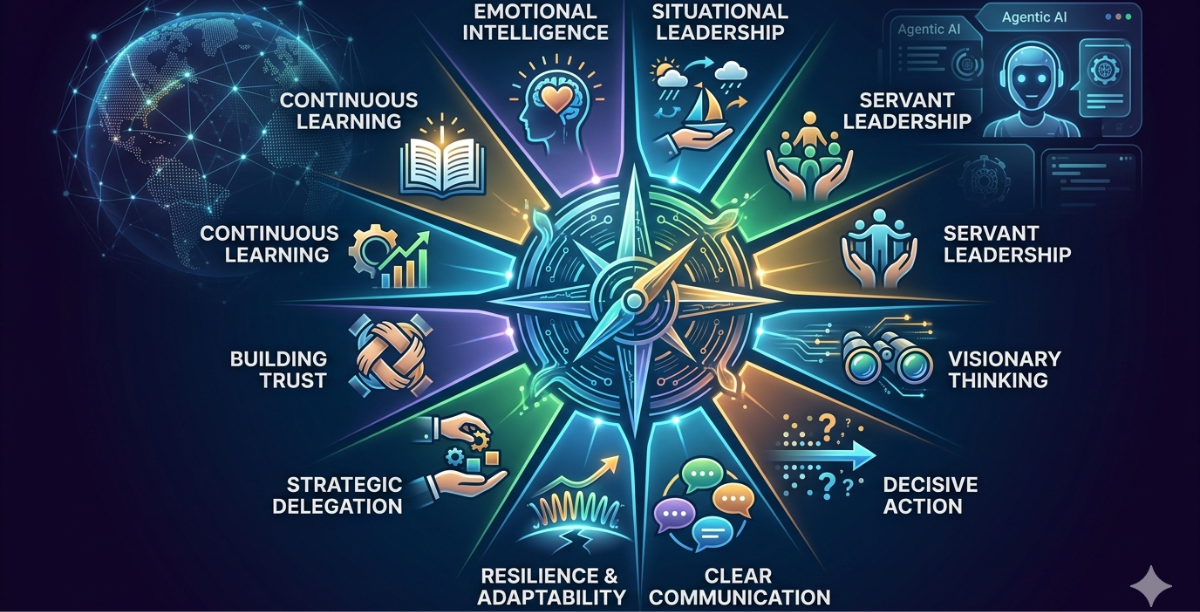
The leadership qualities that made someone effective ten years ago are not the same ones required to lead in 2026.
The pace of change has accelerated beyond anything previous generations of business leaders experienced. Agentic AI is reshaping how work gets done. Remote and distributed teams have become the norm. Economic uncertainty demands resilience and adaptability at every level of an organization. And the expectations placed on business leaders by employees, customers, investors, and communities, have never been higher or more complex.
In this environment, the most successful entrepreneurs and executives are not the ones who rely on authority, hierarchy, or sheer force of will. They are the ones who have developed a specific set of leadership qualities that allow them to inspire, adapt, decide, and sustain high performance over time in themselves and in the people around them.
This guide breaks down the ten most important leadership qualities for business leaders in 2026, drawing on research from Harvard Business School researchers, real-world examples from the entrepreneurial community, and the patterns visible in the leaders who consistently outperform their peers.
Why Leadership Qualities Matter More Than Ever in 2026
Before diving into the specific qualities, it is worth understanding why leadership development has become one of the highest-return investments a business owner or executive can make right now.
The world of work is being fundamentally restructured. As agentic AI takes over more execution tasks, human leadership becomes the primary differentiator between organizations that thrive and those that struggle. The things that AI cannot replicate judgment, empathy, vision, the ability to build genuine trust are precisely the leadership qualities that determine outcomes in 2026.
For women entrepreneurs building businesses in a landscape that is changing faster than ever, and for startup founders navigating their first leadership challenges, developing these qualities deliberately is not optional. It is the foundation on which everything else is built.
The 10 Essential Leadership Qualities for 2026
1. Emotional Intelligence
The research on emotional intelligence and leadership effectiveness is among the most robust in organizational psychology. Leaders with high emotional intelligence, the ability to recognize, understand, and manage their own emotions and those of the people around them consistently outperform those who rely on technical expertise or positional authority alone.
Emotional intelligence in practice means staying regulated under pressure, reading the room accurately in difficult conversations, responding to team members with empathy rather than judgment, and building the psychological safety that allows people to do their best work.
For entrepreneurs managing the stress of building a business while maintaining work life balance and sustaining personal relationships, emotional intelligence is not a soft skill, it is a survival skill.
How to develop it: Practice naming your emotional state before reacting to challenging situations. Ask how people are experiencing a situation rather than assuming you already know.
2. Situational Leadership
One of the most practical and evidence-based leadership frameworks available is situational leadership, the ability to adjust your leadership style based on the specific needs, skills, and motivation of the individual you are leading in any given context.
A situational leader does not apply the same approach to every team member or every challenge. They assess the situation and flex between directing, coaching, supporting, and delegating accordingly.
For business leaders managing diverse teams across different functions and experience levels, situational leadership is the quality that prevents the most common leadership failure, applying a one-size-fits-all approach to people who need fundamentally different things from you.
How to develop it: Before any significant conversation with a team member, ask: what does this person need from me right now – direction, coaching, support, or autonomy?
3. Servant Leadership
The concept of servant leadership introduced by Robert Greenleaf and developed over decades of research and practice, positions the leader’s primary role as serving the needs of their team rather than directing from above.
Servant leaders ask “how can I remove the obstacles slowing my team down?” rather than “how can I get my team to execute my vision more efficiently?” They prioritize the growth and well-being of the people they lead, build cultures of trust, and create organizations where people are motivated intrinsically rather than managed externally.
In 2026, servant leadership has moved from an idealistic concept to a practical competitive advantage. Organizations led by servant leaders consistently show higher engagement, lower turnover, and better performance outcomes.
How to develop it: Start every week by asking your team: what is the biggest thing slowing you down that I could help remove?
4. Visionary Thinking
Great business leaders can see where things are going before most people can and communicate that vision in a way that makes others want to help build it.
Visionary thinking is not about prediction or certainty. It is about pattern recognition, synthesis of diverse information, and the ability to hold a clear picture of a desired future while remaining adaptable about the path to get there.
For entrepreneurs building businesses in rapidly changing industries, visionary thinking is what separates leaders who are constantly reacting to circumstances from those who are deliberately shaping them.
How to develop it: Dedicate thirty minutes weekly to reading outside your immediate industry. The best strategic insights often come from patterns visible in adjacent fields.
5. Decisive Action Under Uncertainty
One of the most consistently cited qualities of great business leaders is the ability to make good decisions quickly with incomplete information, under pressure, and in the face of significant uncertainty.
Most leaders overestimate how much information they need before deciding and underestimate the cost of delayed decisions. The entrepreneurs and executives who build the most consistently successful organizations develop what might be called decision quality — not the ability to always be right, but the ability to make sound, timely decisions and course-correct quickly when new information emerges.
How to develop it: Practice the 70% rule make the decision when you have 70% of the information you wish you had. Waiting for certainty in a fast-moving environment is itself a decision, usually the wrong one.
6. Clear and Authentic Communication
The ability to communicate clearly, honestly, and in a way that lands with different audiences is foundational to every other leadership quality on this list.
Authentic communication means saying what you mean, meaning what you say, and doing so in a way that respects the intelligence and perspective of the people you are communicating with. It means delivering difficult messages with honesty and compassion rather than avoidance.
For entrepreneurs building a personal brand and seeking media coverage to grow their business, communication quality is also the quality that determines whether your story gets told and whether it resonates with the people who need to hear it.
How to develop it: After important conversations, ask yourself: did I say what I actually meant? Did the other person understand it the way I intended? The gap between those two answers is where communication development happens.
7. Resilience and Adaptability
Building a business is one of the most unpredictable journeys a person can take. Markets shift. Products fail. Key team members leave. Plans unravel. The leaders who sustain success over time are not the ones who avoid these challenges, they are the ones who recover from them faster and extract more learning from them than their competitors.
Together resilience and adaptability create what Harvard Business School researchers have called change fitness, the organizational capability to move through transformation without losing effectiveness.
How to develop it: After every significant setback, ask three questions: What happened? What did I learn? What will I do differently? The habit of structured reflection turns difficulty into development.
8. Strategic Delegation
One of the most common leadership failures among entrepreneurs is the inability to let go. The founder who built the business by doing everything themselves often struggles to trust others with the work, resulting in a bottleneck that limits growth and drives burnout.
Strategic delegation is the leadership quality that transforms a founder into a genuine business leader. It requires clarity about what only you can do, systems that allow others to do everything else, and the willingness to accept outcomes that are good enough rather than perfect.
For women entrepreneurs scaling their businesses and startup founders making the transition from individual contributors to team leaders, delegation is often the single most impactful leadership skill to develop.
How to develop it: Identify the three tasks you do regularly that someone else could do at 80% of your quality. Delegate one this week.
9. Building and Sustaining Trust
Trust is the foundation of every leadership relationship and it is both harder to build and easier to destroy than most leaders appreciate until they experience the consequences of its absence.
Trust is built through consistent behavior over time doing what you say you will do, being honest when honesty is uncomfortable, and showing up reliably when your team needs you.
For leaders seeking to build visibility through a business spotlight or CEO interview, the trust they have built with their teams and clients is ultimately what their reputation is made of, and what makes their story worth telling.
How to develop it: Audit your commitments regularly. Are there promises you have made that you have not kept? The fastest way to rebuild trust is to acknowledge the gap and close it.
10. Commitment to Continuous Learning
The final and perhaps most foundational leadership quality for 2026 is a genuine, sustained commitment to learning, about your industry, about leadership itself, about the people you lead, and about the world your business operates in.
For entrepreneurs tracking trending topics in their industry, for executives navigating the implications of agentic AI, and for anyone building a business in an environment that rewards adaptability continuous learning is not a personal development aspiration. It is a competitive requirement.
How to develop it: Commit to one hour of deliberate learning per week deep reading, courses, mentorship, or reflection specifically aimed at developing your leadership capability.
Final Thoughts
The leadership qualities that matter most in 2026 are not innate traits that some people have and others do not. They are skills. They can be learned, practiced, and developed by anyone willing to invest in them.
The leaders who build the most successful businesses, who attract the best talent, and who sustain high performance over years, are almost universally people who took their own leadership development seriously.
Your business will only grow as far as your leadership allows.
CEO Medium tells the stories of entrepreneurs and business leaders who are doing remarkable things. Want your leadership story featured? Get Featured Today or email info@ceomedium.com.
