
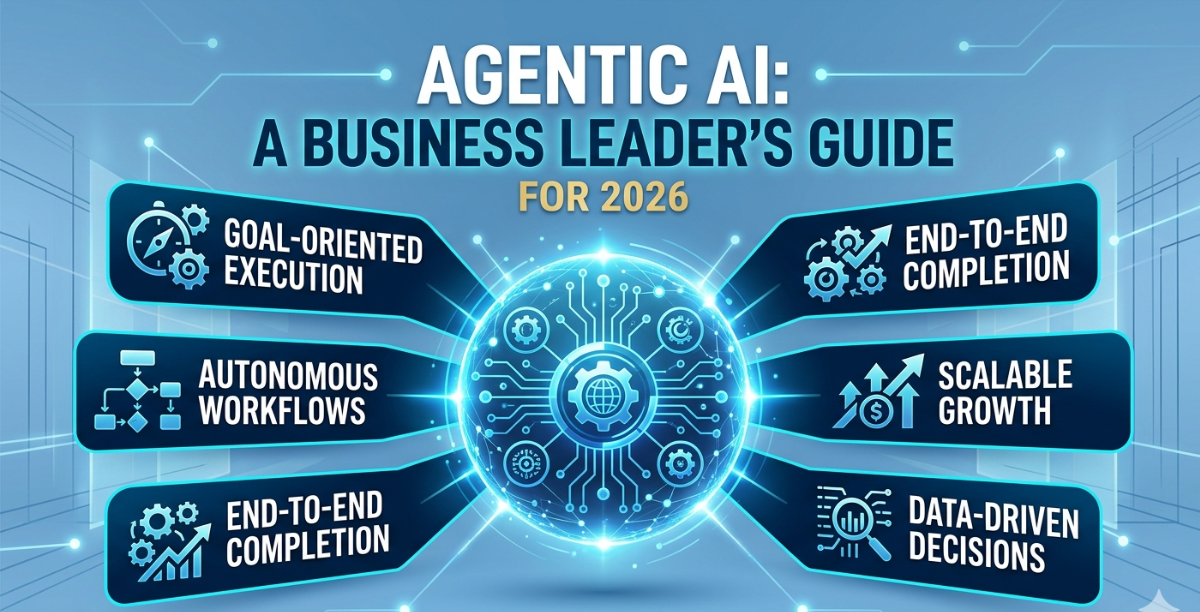
AI leadership is the defining competitive advantage of 2026 and most business leaders do not realize they are already behind.
That gap between using AI to assist humans and using AI to run entire workflows autonomously is the defining business divide of 2026. It has a name: agentic AI. And if you have not heard of it yet, you are already behind the curve.
In my experience working with entrepreneurs and executives across industries, the leaders who win over the next three years will not necessarily be the ones with the biggest budgets or the most experienced teams. They will be the ones who understood agentic AI early — before it became mainstream and built their businesses around it while their competitors were still running pilots.
This article explains what agentic AI is, why it matters more than anything else in business technology right now, and exactly what you need to do as a leader to get ahead of it.
What Is Agentic AI and Why AI Leadership Matters Now?
Most people’s understanding of AI in business starts and ends with chatbots and content generation tools. You type a prompt, the AI responds, you edit the output and move on. This is AI as an assistant useful, time-saving, but fundamentally limited by the fact that a human still needs to direct every step.
Agentic AI is fundamentally different.
An AI agent does not wait for instructions. It is given a goal “find the top 50 leads in this market segment and draft personalized outreach for each one” and then it plans, executes, evaluates, and adjusts until that goal is achieved. It works across multiple tools, makes decisions along the way, and completes multi-step tasks that previously required an entire team.
The shift from AI as assistant to AI as autonomous agent is not incremental. It is the difference between having a calculator and having an employee who never sleeps, never makes careless errors, and can work on a hundred tasks simultaneously.
Why Agentic AI Is the Most Important Business Trend of 2026
The numbers tell the story clearly.
According to Gartner, by 2027 context-specific AI models will be used at least three times more often than the large general-purpose models that dominate today. The direction of travel is toward specialization and autonomy AI that does specific things extraordinarily well without human direction at every step.
Major corporations are already seeing tangible results. Walmart uses AI agents to handle payroll processing, support merchandising teams, and help customers find products. AstraZeneca deploys AI agents as research assistants, automating repetitive scientific tasks, processing massive datasets, and accelerating the path from insight to discovery.
These are not experiments. These are production systems running core business functions.
For smaller businesses and entrepreneurs, the implications are even more significant. Agentic AI does not just help large companies operate more efficiently, it gives small teams the capability to compete with organizations ten times their size. Getting your business featured in the right business magazine amplifies that competitive advantage even further.
As Harvard Business School faculty noted in their 2026 AI trends report, AI is no longer an experiment on the side. It is rewiring how work gets done, shifting from isolated tools people choose to adopt to platforms that sit at the center of workflows, decisions, and customer journeys. For business leaders looking to build visibility alongside capability, understanding how media coverage works in 2026 is equally important.
The window to get ahead of this shift is right now. Not in six months when every business publication is writing about it. Right now, when most of your competitors are still figuring out how to write better email subject lines with ChatGPT.
5 AI Leadership Skills Every Business Leader Needs in 2026
1. It Changes What Leadership Actually Means
The skills that made someone an effective business leader in 2020 are not the same skills required in 2026. When AI agents can handle analysis, research, scheduling, customer communication, and even basic decision-making, the human leader’s role shifts fundamentally.
The most valuable leadership capabilities in an agentic AI world are:
Problem definition. AI agents are extraordinarily good at executing toward a clearly defined goal. They are completely useless when the goal is vague or poorly framed. The leader’s most important skill becomes the ability to define problems with precision and clarity.
Judgment over execution. When AI handles the execution of tasks, human value concentrates in the judgment calls that machines cannot reliably make — ethical decisions, relationship management, creative direction, and navigating ambiguity. Building your personal brand as a leader is one of the most powerful things you can do in an agentic AI world.
AI literacy. You do not need to understand how to build AI systems. You do need to understand what they can and cannot do, where they are reliable and where they fail, and how to evaluate their output critically rather than accept it uncritically.
2. The Competitive Advantage Window Is Narrow
Every major technology shift in business history has followed the same pattern. Early movers gain a significant advantage. The mainstream catches up. The advantage disappears. Late movers spend years trying to recover ground.
Agentic AI is at the early mover stage right now. The businesses deploying AI agents for sales prospecting, customer service, content production, research, and operations today are building a lead that will be very difficult to close in 12 to 24 months.
This does not mean rushing into AI for its own sake. It means deliberately evaluating where in your business autonomous AI could replace or augment human effort — and starting to build that capability now while the competitive landscape is still open.
3. Small Businesses Have More to Gain Than Large Ones
Large enterprises move slowly. They have legacy systems, regulatory constraints, change management challenges, and organizational inertia that make rapid AI adoption genuinely difficult.
Small businesses and entrepreneurs have none of those constraints.
A founder who adopts agentic AI tools for lead generation, customer communication, research, and content production can operate with the output of a team five times larger — at a fraction of the cost. This is one of the most significant competitive advantages available to small business owners and entrepreneurs in 2026, and most are not taking advantage of it.
The entrepreneurs who figure this out in the next six months will look back on 2026 as the year everything changed.
4. The Risk of Moving Too Slowly Is Greater Than the Risk of Moving Too Fast
Most business leaders approach new technology with caution — which is generally wise. But with agentic AI, the calculus is different. The risk of being left behind is now greater than the risk of early adoption mistakes.
This does not mean deploying AI agents recklessly across mission-critical functions without testing. It means treating AI capability building as a strategic priority rather than a future consideration. Start with lower-stakes applications. Build internal understanding. Develop processes for evaluating AI output. Learn what works in your specific business context.
The leaders who wait for certainty will find that by the time they act, their competitors have already locked in the advantages.
5. Your Team Needs to Evolve With You
Introducing agentic AI into your business is not purely a technology decision. It is a leadership and culture decision.
Harvard Business School research makes this clear — organizations need to design roles with high content of continuous learning to ensure employees acquire capabilities that matter in an increasingly AI-led environment. Alongside technical AI knowledge, higher-level analytical abilities and domain expertise will be the skills that command the highest value.
As a leader, your responsibility is not just to deploy AI tools. It is to bring your team with you — helping them understand how their roles are evolving, what new skills they need, and how AI makes their work more valuable rather than less necessary.
The leaders who handle this transition well will retain their best people through it. The ones who do not will lose them to organizations that did.
AI Leadership in Practice: Where to Start Today
If you are reading this and thinking “I need to do something about this but I don’t know where to begin” — here is a clear starting point.
Step 1 — Map your highest-repetition tasks. Spend one hour listing every task in your business that happens repeatedly and follows a predictable pattern. These are your AI agent candidates — the functions where autonomous AI can take over immediately.
Step 2 — Identify your highest-value human activities. What do you and your team do that genuinely requires human judgment, creativity, relationships, or expertise? These are the activities you should be freeing up time for by offloading the repetitive ones to AI.
Step 3 — Start with one agent in one function. Do not try to transform your entire operation at once. Pick the single highest-repetition, lowest-risk function and deploy an AI agent for it. Learn from that experience before scaling.
Step 4 — Build AI literacy across your leadership team. Your leaders do not need to become AI engineers. They do need to understand the landscape well enough to make informed decisions about where and how to deploy these tools. Invest in that literacy now.
Step 5 — Revisit your strategy every 90 days. AI capability is evolving faster than any previous technology wave. What is state-of-the-art today may be superseded in 90 days. Build a regular rhythm of reviewing the landscape and updating your approach accordingly.
The Leaders Who Will Win the Next Decade
The business leaders who thrive over the next ten years will not be the ones who were most resistant to AI. They will not be the ones who adopted it blindly either. They will be the ones who approached it with clear eyes — understanding what it can and cannot do, deploying it strategically where it creates genuine leverage, and using the time and capability it frees up to do the things that only humans can do well.
Agentic AI is not the future of business. It is the present — and the gap between leaders who understand this and those who do not is widening every month.
The question is not whether agentic AI will transform your industry. It is whether you will be the one driving that transformation or the one trying to catch up to it.
CEO Medium covers the stories, strategies, and ideas that matter to today’s business leaders. Want to share your leadership story with our growing audience? Get Featured Today or email info@ceomedium.com
